No mountaineering background. Just the decision to go.
Mt. Rainier. August 2012. One summit bid, no experience, plenty of excuses.
AUGUST 1, 2012 Bound for Seattle
Ever end up next to exactly the right person on a flight? The older gentleman to my left lived in Seattle and climbed Rainier every year, sometimes twice, was full of insight, and somehow we ended up next to each other. An elderly woman to my right had been listening and eventually joined in, warm and curious, full of questions about our "adventurous souls." I wanted sleep but couldn't because she talked the ENTIRE flight. Worth every lost minute of sleep ;)
After landing, parting ways, and retrieving my luggage, I waited outside for my shuttle where the weather couldn't have been more perfect. There was already a different quality to the air. Prior to my climb, I drove out to the other side of Puget Sound from Seattle and spent a few days with my dad to help calm the mind. Always serene. Great for relaxing and slowing life down before everything changes.
AUGUST 4, 2012Peek-a-boo
The ride to basecamp, Whittaker's Bunkhouse, was perfect; rolling with the windows down, sunroof open, and wind blowing. On this day, Rainier was "out." Rainier has the highest prominence in the lower 48, which makes it visible from over a hundred miles away and makes the drive to the mountain like a game of hide and seek. At times it’s hidden behind trees or peering over smaller ranges, and at every open turn you can't help but look for it. Occasionally it appears out of nowhere, without obstruction across the valley floor, just begging you to pull over and capture that Kodak moment.
It doesn't look like something you're supposed to climb. It looks like something you're supposed to stare at.
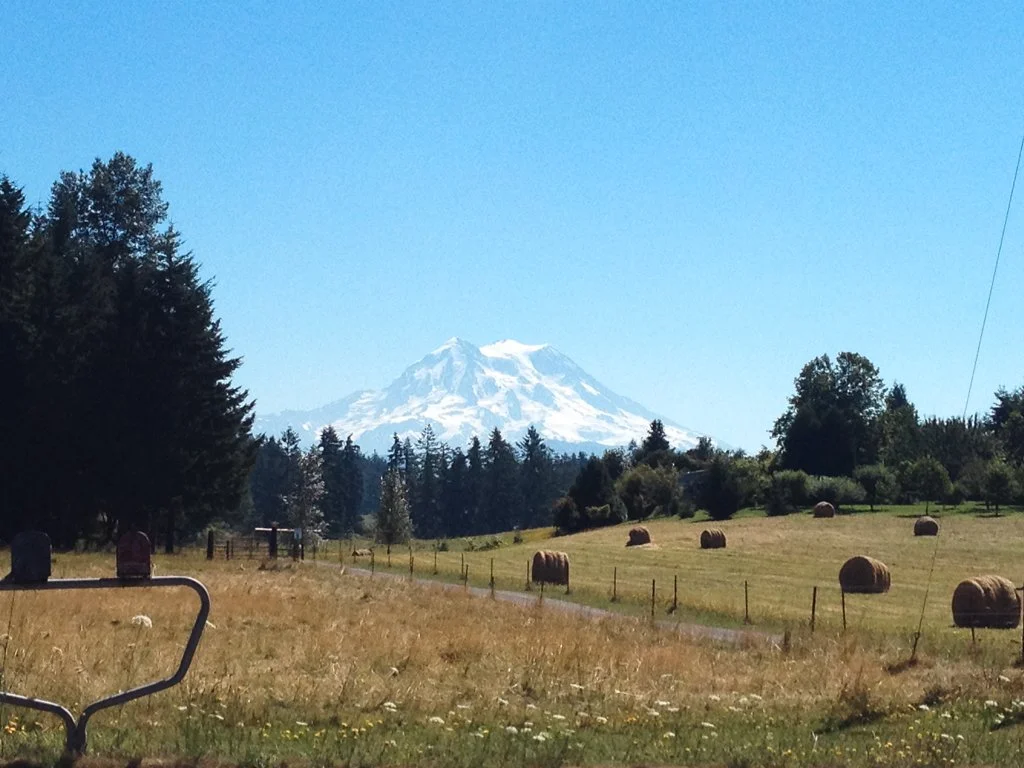
Mount Rainier across the valley floor
AUGUST 5, 2012Training day
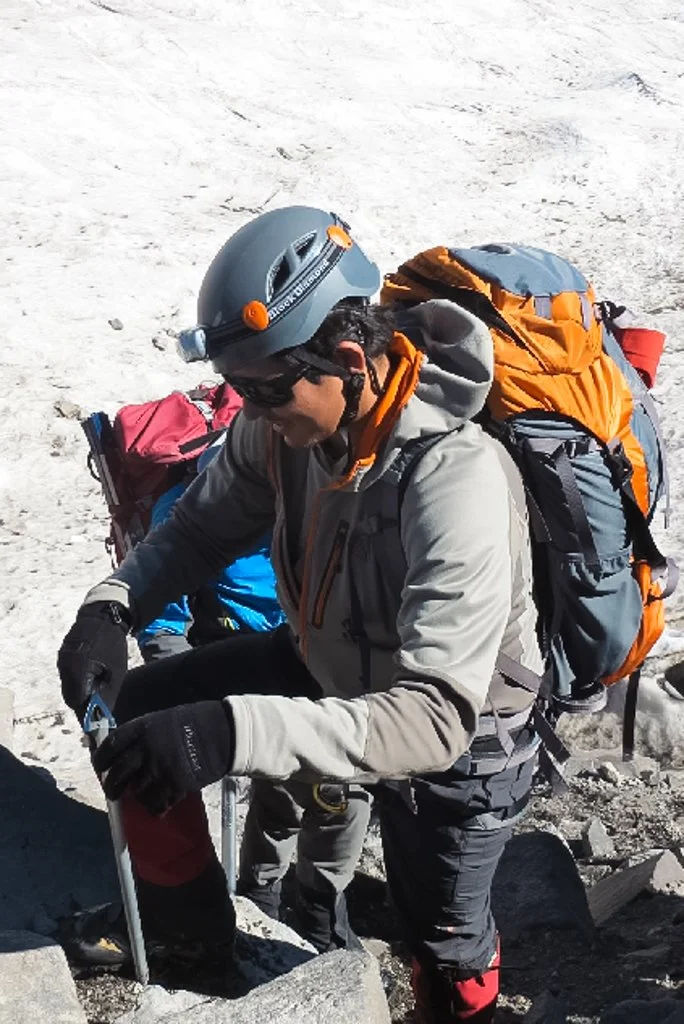
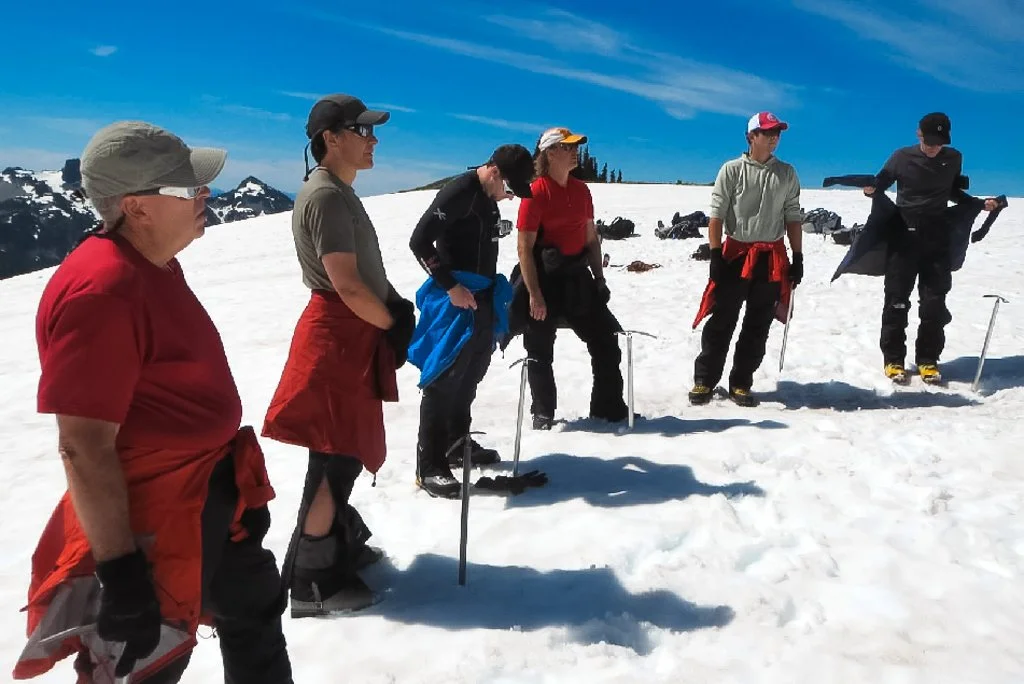
A full day on the mountain, the bulk of it focused on a single skill: self-arrest. If you slip on steep glaciated terrain, you have seconds to get on your stomach, drive the pick of your ice axe into the slope, and press your entire body behind it. The mountain’s the brake pad and you're the force. Get it right, you stop. Get it wrong, well, you know. You practice it until the motion is automatic, until your hands know what to do before your brain has finished deciding, because if you ever actually need it, thinking will be too slow.
AUGUST 6, 2012Eat a little. Drink a little.
Today was the first real test, and we hadn't even started climbing.
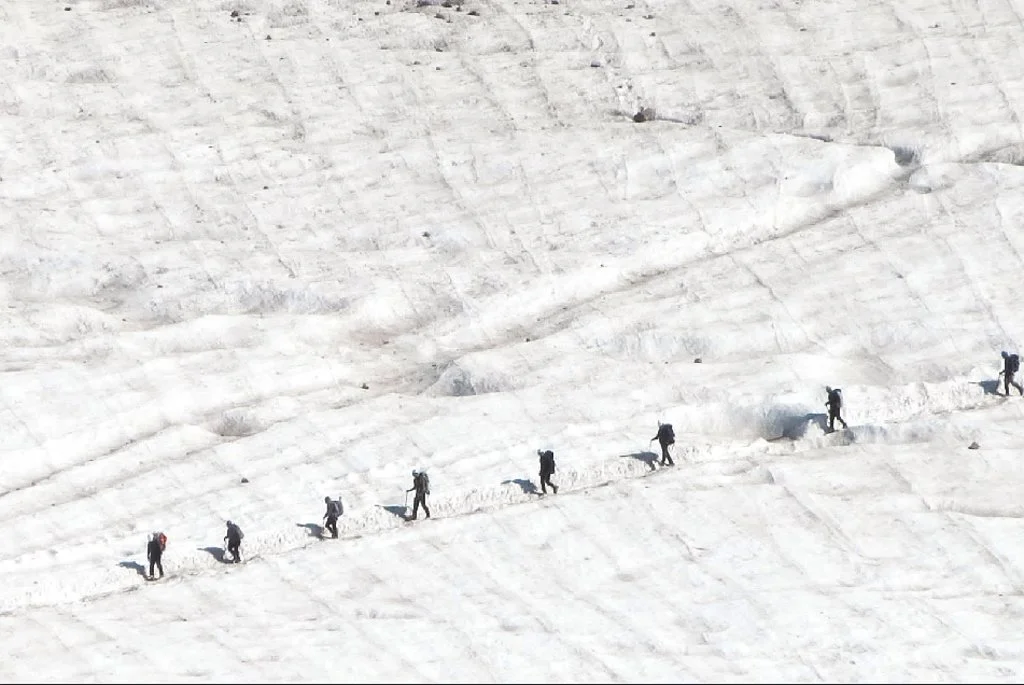
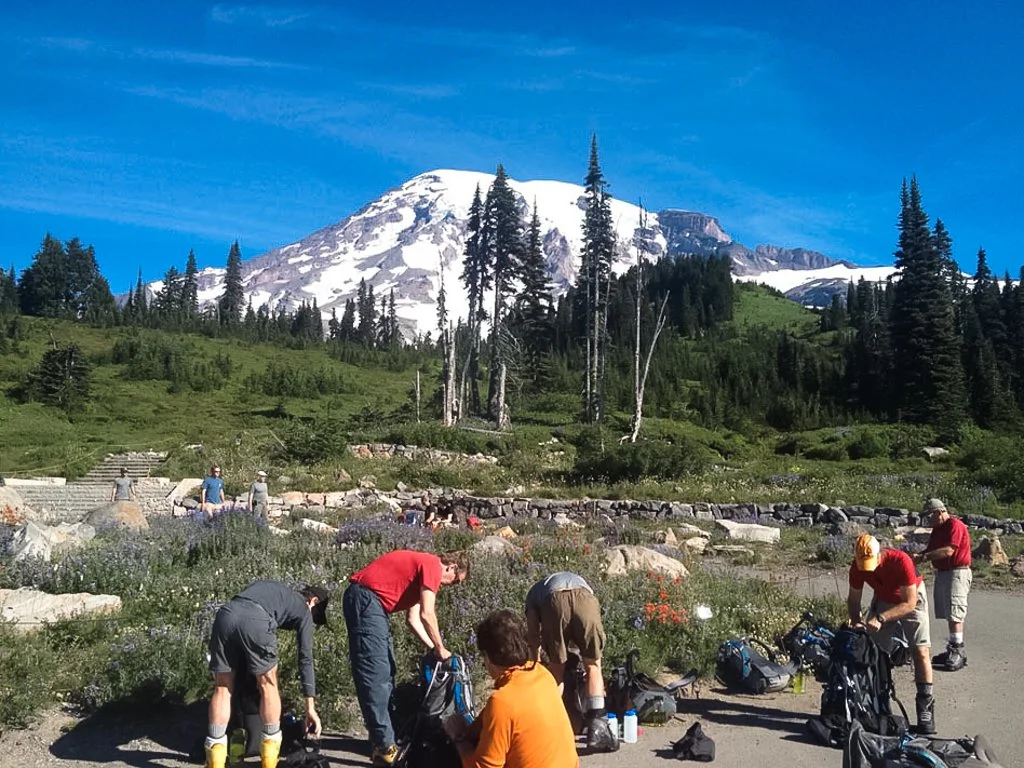
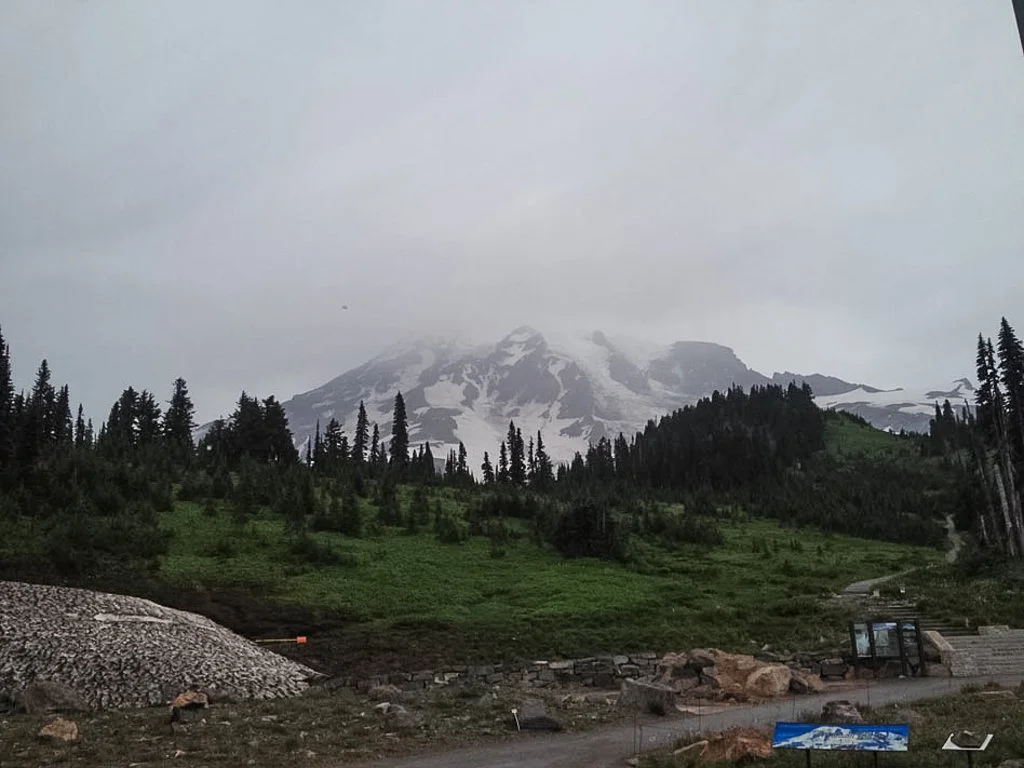
4.5 miles, 4,600 feet of elevation gain, a 40 to 45 pound pack on your back, and a trail that starts paved before going to dirt and rock, then to snow for about 90 percent of the way up, no doubt a tough one! And not only is it physically demanding, but Rainier is notorious for generating its own weather, where at any point conditions can swing from a sunny summer to a dreary winter with visibility dropping from miles to near nothing within the hour. Thankfully, for us, the morning's grey and slight drizzle gave way to sunny skies within the first hour.
Just not before this. We weren't even thirty minutes in when the guides stepped off to the side, radios out, talking quietly among themselves. Shortly after, search and rescue passed us heading up, pulling what looked like an off-road gurney. With brows raised, we asked and were told that the bodies of two climbers who had gone missing months earlier had been located on the glacier. Caught in one of those storms the mountain spins up out of nowhere. It's the kind of moment that doesn't need a word. The mountain had already said everything it needed to say, and we hadn't even reached basecamp.
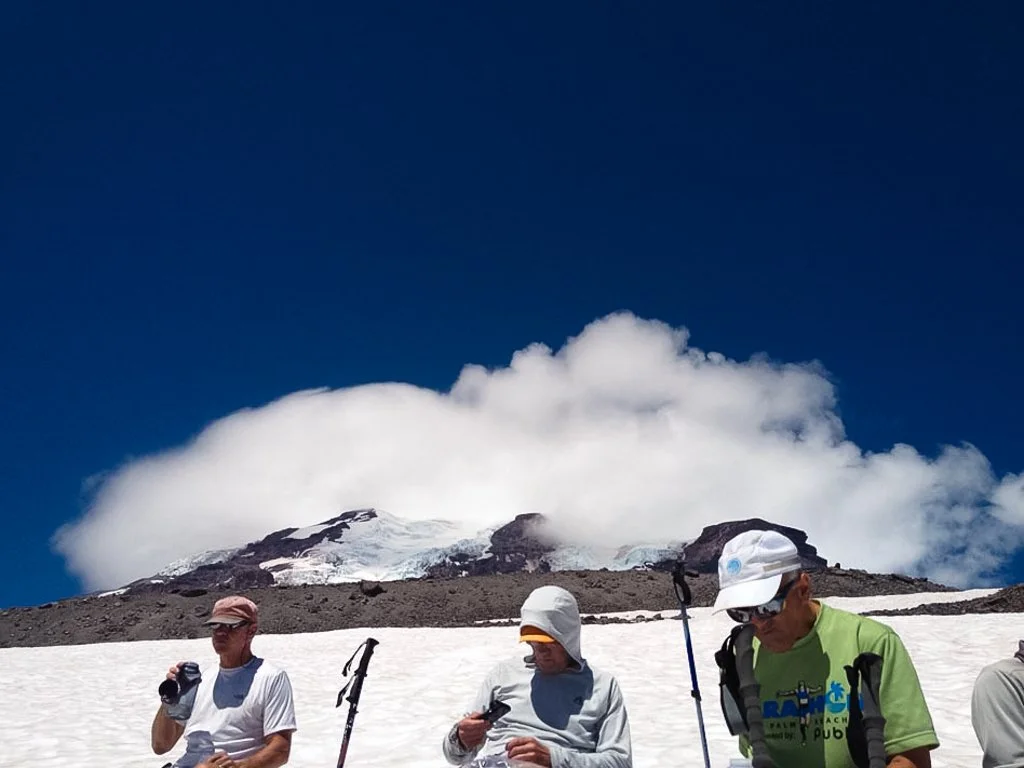
We hiked for an hour at a time with short 15-minute breaks in between, where we would, as Win would put it, "Eat a little, drink a little." And real quick, our guides Win Whittaker, Ben, and Andy. These guys practically grew up on this mountain. Win's family started the RMI guide service in the late 60’s, and his father led the first successful American summit of the North Col of Everest. Between Win and his brother Peter, they've summited Rainier over 400 times combined. And after the news we’d just received, we couldn’t have felt any better about who was leading us up that mountain.
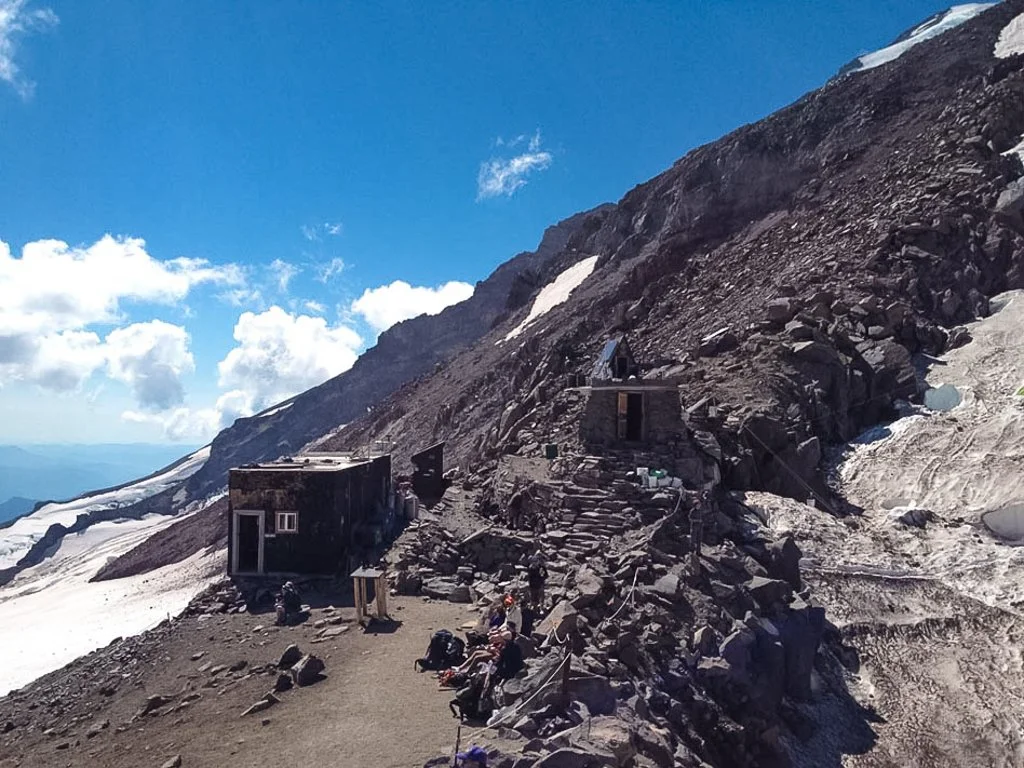
Tired and exhausted, we stumbled into Camp Muir around 2:30pm. The Muir shelter, a plywood bunkhouse that slept 18, was home for the next couple of nights. After a warm meal and watching the sun creep below a nearby ridge, I turned in for the night.
AUGUST 7, 2012Rest day
Rest day, yes. Restful morning, nope. Earplugs do a decent job with snoring. What they can't do is block out nine other climbers rustling at midnight, layering up, checking gear, quietly psyching themselves up for their own summit bid. I sat up, chatted a bit, said good luck, ate a midnight snack, and accepted that this particular rest day had its limits.
Looking back at my notes from that night, I had to laugh. I'd written: "I'd like to shit, but it's too damn cold and windy outside!" What I didn't write down, but will never forget, is that the outhouse had an updraft situation that created a swirling paper waste scenario you didn’t want a part of. Nobody puts that in the brochure!
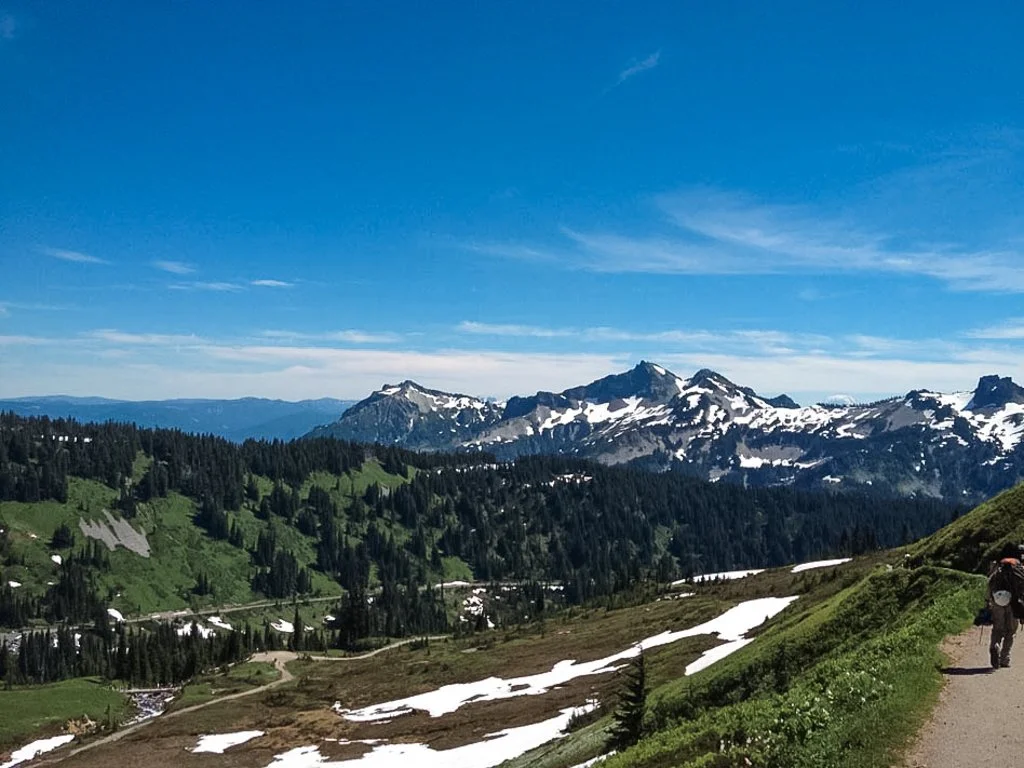
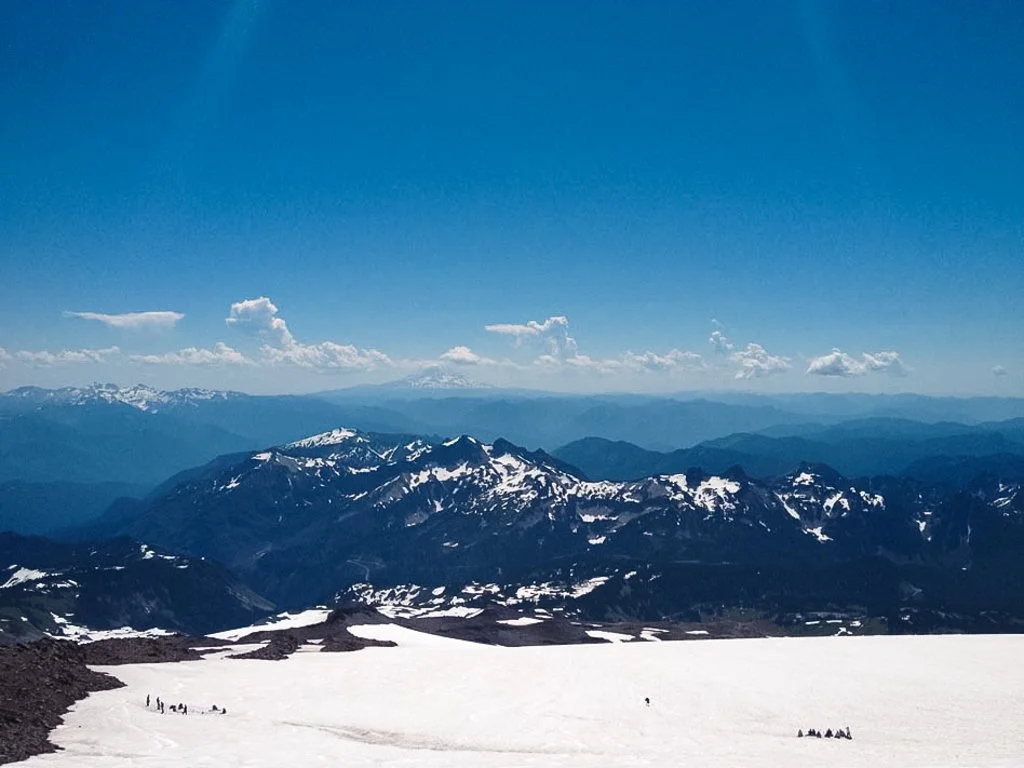
Once the day got properly started, a short hike up to Muir Point opened up to blue skies and gorgeous views.
AUGUST 7, 2012Dropping into a crevasse
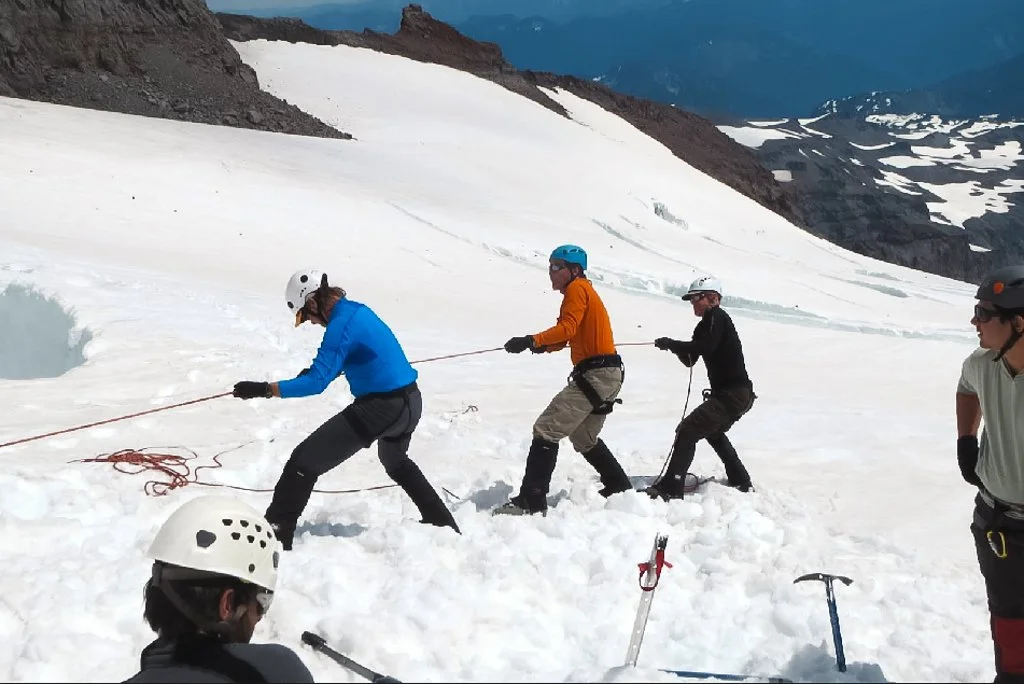
Further into our rest day, we strapped on harnesses, roped up, and headed out onto Cowlitz Glacier. A glacier! A glacier riddled with crevasses. Crevasses! Massive cracks in the ice that drop who knows how far down. You're literally stepping around and over things that could swallow you whole. So yeah, we're out there picking our way through this field of potential catastrophe when Win turns to the other guides and asks, casually, "Should we lower them here?"
I was secretly hoping for this seeing they brought out a good bit of gear just to meander about. And sure enough.
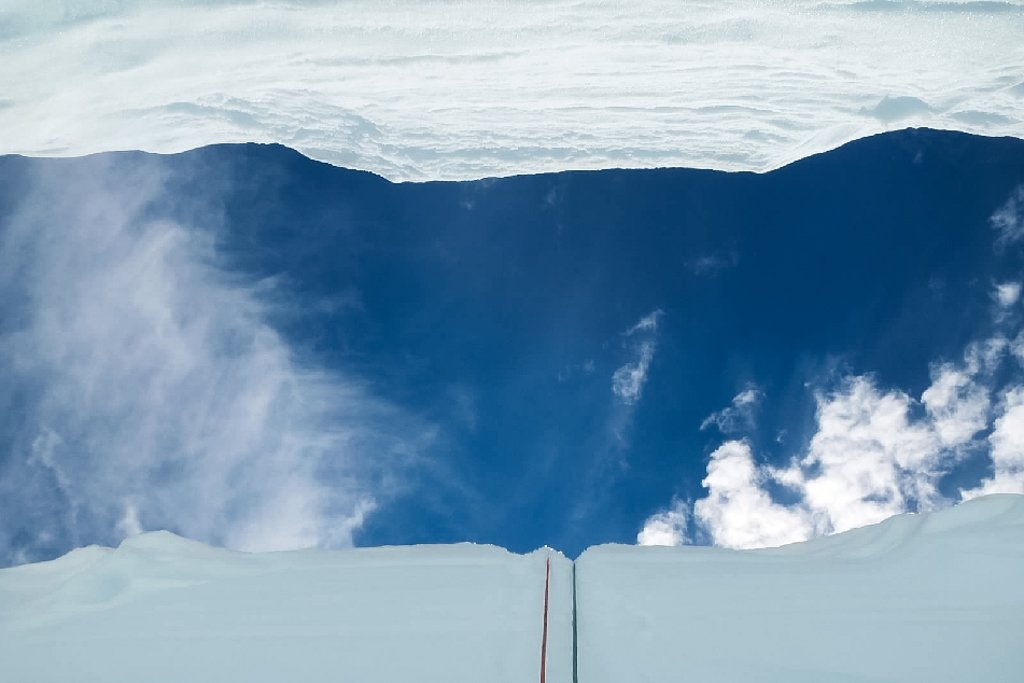
Down we went! Twenty-five feet between walls of deep blue ice, the bottom somewhere way beyond the reach of any light I had. And I mean way down. You understand intellectually that glaciers are ancient and massive, but dangling inside one is a completely different kind of knowing. You feel genuinely, uncomfortably small in a way that's hard to explain without having been there. Incredible doesn't cover it.
After getting pulled back up, high fives all around! That was insane. Exhilarating, surreal, a little terrifying, and somehow we're supposed to now wind down and get some sleep before a midnight wake up call for our shot at the summit. Sure. Lights out!
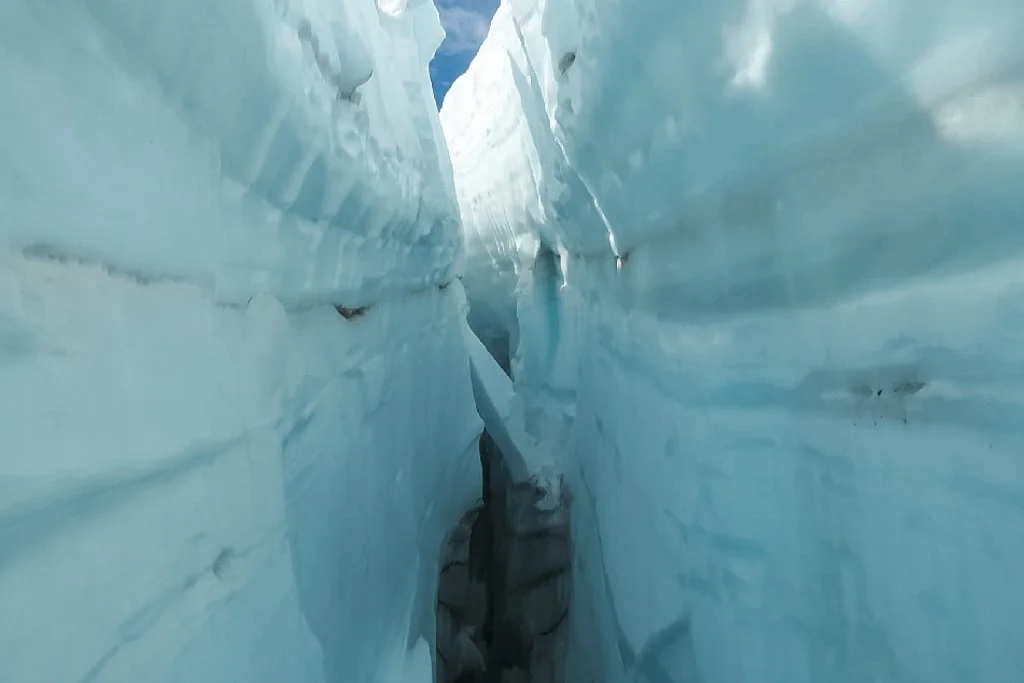
Cowlitz Glacier Crevasse
AUGUST 8, 2012Summit day!
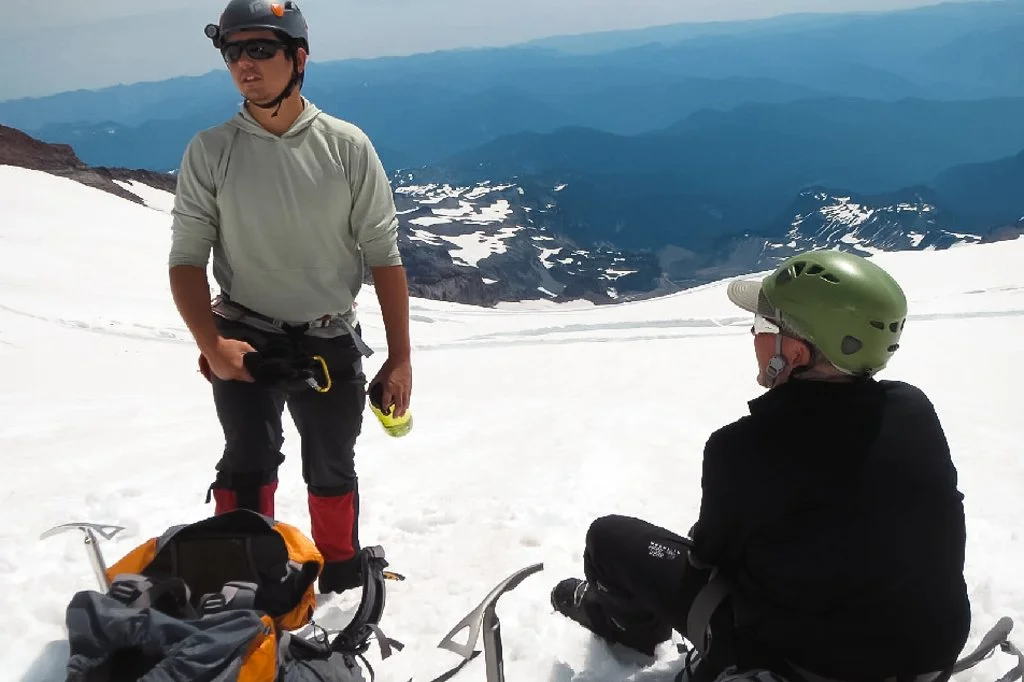
Here we go! Layers, check! Gear, check! Breakfast, check! Big smile and great attitude, hell yeah! And you better take care of a number two before you leave. Because the last thing you want is to have to stop the whole operation, drop your layers in however many degrees, handle your business into a bag, seal it, and pack it while fully exposed to your rope team with each person 20 to 30 feet apart, with other rope teams above you and below you and not a tree or rock to hide behind in sight. No thanks!
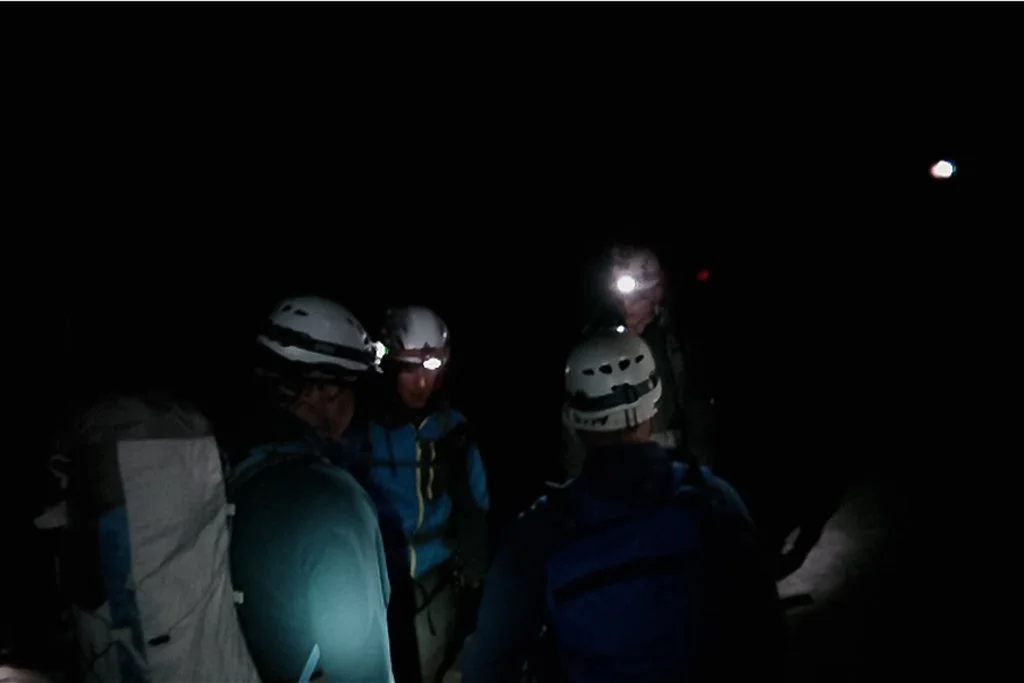
Sorry, I digress. Everything moves pretty quickly when waking up at 12:15am with many others all trying to do the same thing in a confined space. Once everyone was layered up and ready, we made our way outside and down to Cowlitz, huddled up, and made some last-second adjustments. As I stood there waiting for the word to go, I found myself in a blur of darkness, dim headlamps moving all around me, and just for a brief moment everything seemed to stop. It was one of those in-the-moment experiences where I was truly realizing for the first time that this was real and this was happening. Looking down, I caught my light bouncing off my crampons. I quickly snapped back to take stock of everything else: boots, gaiters, harness, avalanche transceiver, goggles, helmet, headlamp, and the rope connecting me to two others and our guide. It was a reality check. I don't even know how to describe what was running through me right then. Everything. All of it. At once.
About half of everyone who attempts to summit Rainier never reaches the top. The route we were about to embark on is considered the standard route. Standard by who? Certainly not me!
"Mount Rainier is perhaps the single most impressive mountain in the 48 contiguous United States. No other peak has the combination of high elevation, massive bulk, and extensive glaciation. In most of the United States, a hike of 3,000 vertical feet to the summit is considered about average. Mt. Rainier, by its easiest route, requires ascending 9,000 vertical feet. This distance is the same as the climb from advance basecamp in the Western Cwm to the summit of Mt. Everest."
— PeakBagger
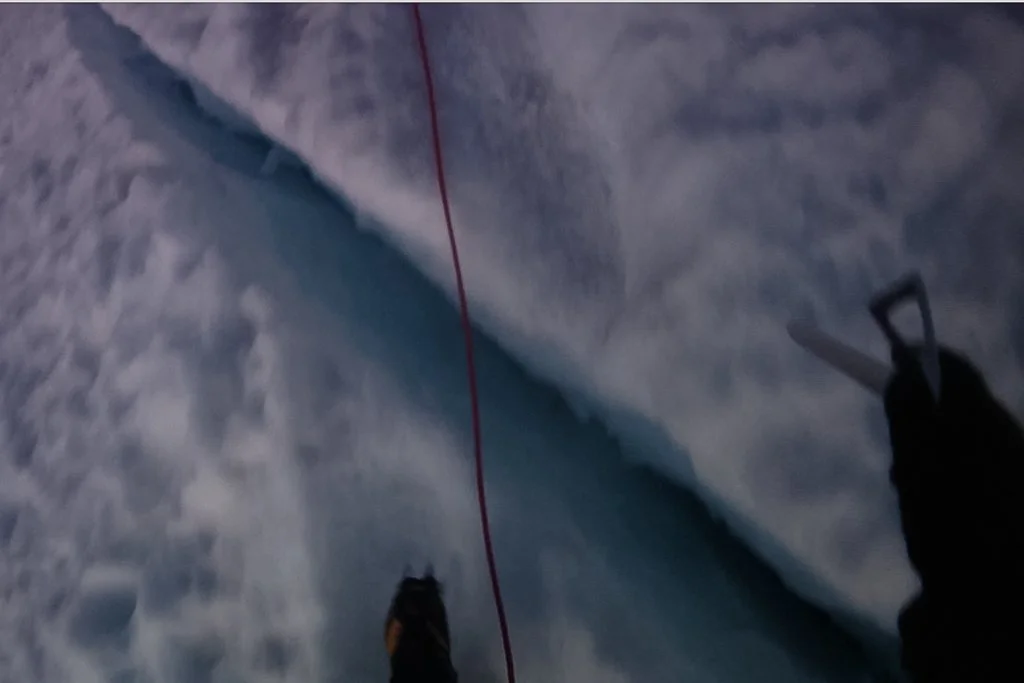
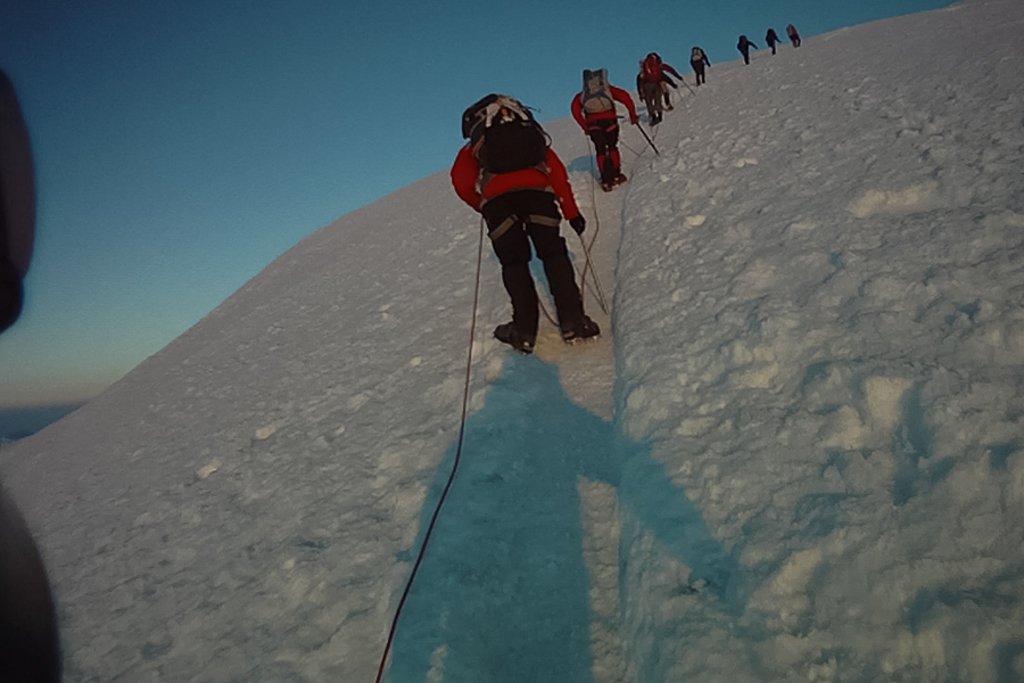
We began by traversing Cowlitz Glacier to Cathedral Gap, a rock and scree section leading up to The Flats at 11,200 feet, where we took our first break. Two people in our group turned back here. You can train hard for a climb like this, but altitude operates on its own logic and it doesn't care how fit you are; the mountain ultimately makes that call. After reorganizing the rope teams, we continued up through what I think is the most dangerous section of the climb — Disappointment Cleaver, or DC, from 12,300 feet up to High Break at 13,500.
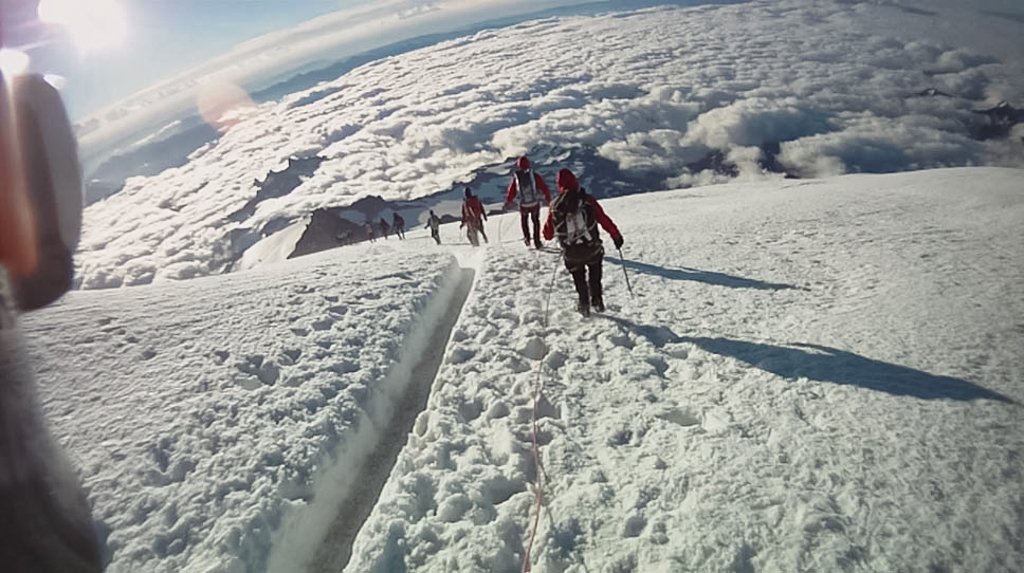
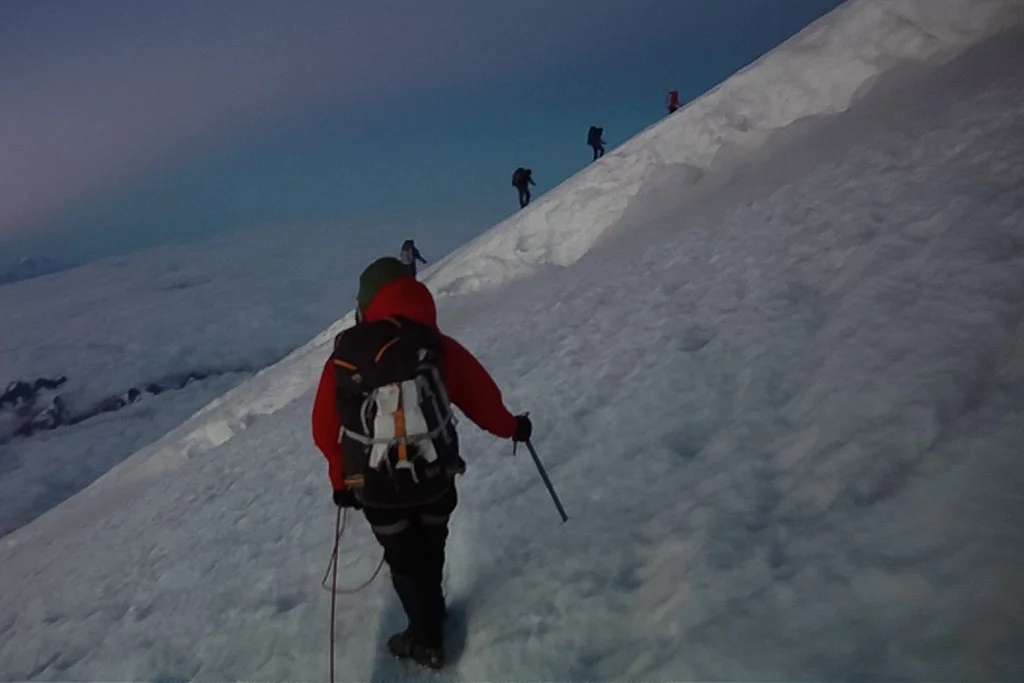
It's completely dark except for your headlamp. The path is only a few feet wide, with your right foot occasionally finding the edge. The pitch is around 35 to 40 degrees. Gusts up to 20 to 30mph. And when you glance down to your right and your light is met with darkness, you realize you’re standing on edge! You pull your focus back to what's directly in front of you and keep moving, one very slow and deliberate step at a time, one rope team ahead and one behind, the whole line working its way up the face together.
High Break is the last stop before the summit, and this is where you have to get real with yourself. Are you still an asset to the rope team or are you becoming a liability? Are your legs giving out? Is your head right? If you're slowing the team down or putting them at risk that's on you to say so. Nobody's going to judge you for it. Two people in our group already made that call at The Flats. But if you don't say it and something happens, that's a different conversation entirely. So you get honest. Really honest. Otherwise, to the top!
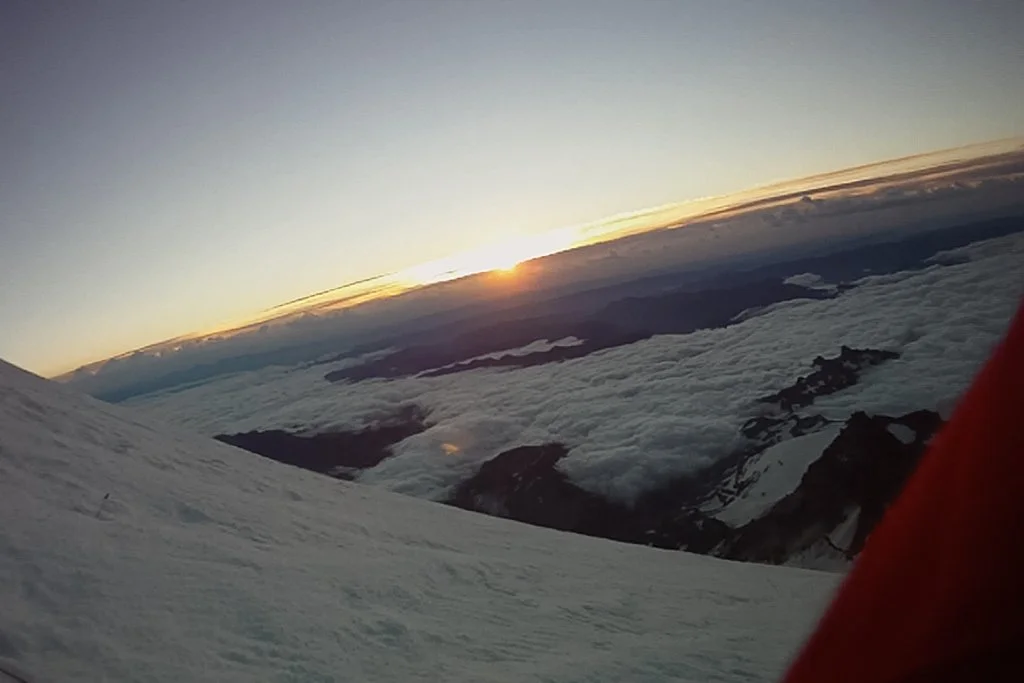
By this point the first curve of the sun had started to crest the horizon. Our guide stopped the team, and we stood there for a moment, still roped together above the clouds, and just let the warmth hit our faces. What came next, though, proved to be the hardest stretch with winds up to 35mph and two of the widest crevasse crossings (a couple of feet wide) of the entire climb, though by this point we'd already crossed about a dozen. And somewhere in that stretch, I reached for my inhaler … and couldn't find it!
I haven’t mentioned having asthma!? Prior to this point I'd already used it twice. Needing to stop the team, I checked every pocket, inside and out, mid layer and outer layer. Nothing. If you have asthma as well, you know that at altitude, in cold air, under that kind of physical output, that's not a small thing! I felt the anxiety start to rise but had to shut it down fast, because the last thing you want to do when you're struggling to breathe is to panic about breathing! So, I slowed everything I could control. Breath, pace, focus. And kept moving.
There were a couple moments I genuinely questioned whether I had anything left. And then I started thinking about my daughter, teared up as I said out loud, "C'mon Rylee, we got this!" Obviously, she wasn't there, but she certainly helped me get through it!
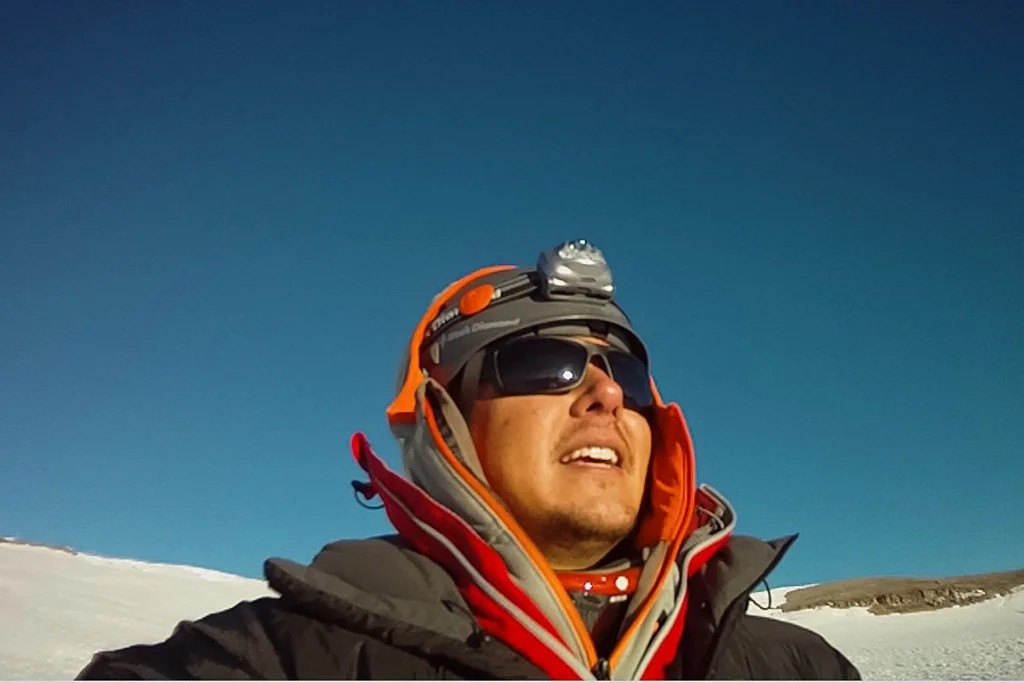
Finally! We reached the summit around 7am. Twenty-five degrees, winds 40 to 45mph. Our time at the top was limited, but we had enough time to congratulate each other, eat a little, drink a little.
There's something that happens when you do something you genuinely weren't sure you could do. Not the rush of it, but the quiet after, when you realize the doubt was real and you went anyway. That's the part that stays.
AUGUST 8, 2012The hard part
Believe it or not, the hard part had yet to come. “You mean the summit wasn’t the hard part?” Nope! Summit-tagged and spent, we still had 9,000 feet between us and Paradise. And what nobody tells you is that descending is harder on the body than going up. Every step down is your quads, knees and ankles absorbing impact on muscles that already have nothing left. Feet, shins, legs, shoulders from two days of pack weight … all of it cashing in at once.
We took a different route down, bypassing DC entirely, which meant primarily snow fields instead of that two-foot wide path with the near-straight drop. At one point we watched an ice fall play out in the distance; far enough away to be safe, close enough to be a reminder.
The guides also introduced us to the standing glissade on the way down. Essentially boot skiing on snow. Sounds fun and easy, but! Way harder than it sounds. Faster, yes. Your entire body working to stabilize and control the slide, all while your legs have absolutely nothing left. But hey, it's "fun,”right!?
During one of the longer breaks on the way down, temps slightly warmer, I dug into an outer coat pocket again … right there, my inhaler! Could’ve used you earlier! But, at least I had you now, where I needed you again.
The relief was disproportionate and entirely proportionate at the same time. I sat there a moment and just let it land, after a couple puffs, of course.
Back at Paradise we loaded up the van and drove the 45 minutes back to Whittaker's Bunkhouse. Win didn't need to say it twice, "Cold beers and pizza at the bar and grill!" That's where the stories came out. Every low, every high, every moment someone almost didn't make it and did anyway. No grand epiphanies. Just a bunch of dudes around a table, smelling exactly like you'd expect. Celebrating a summit.